
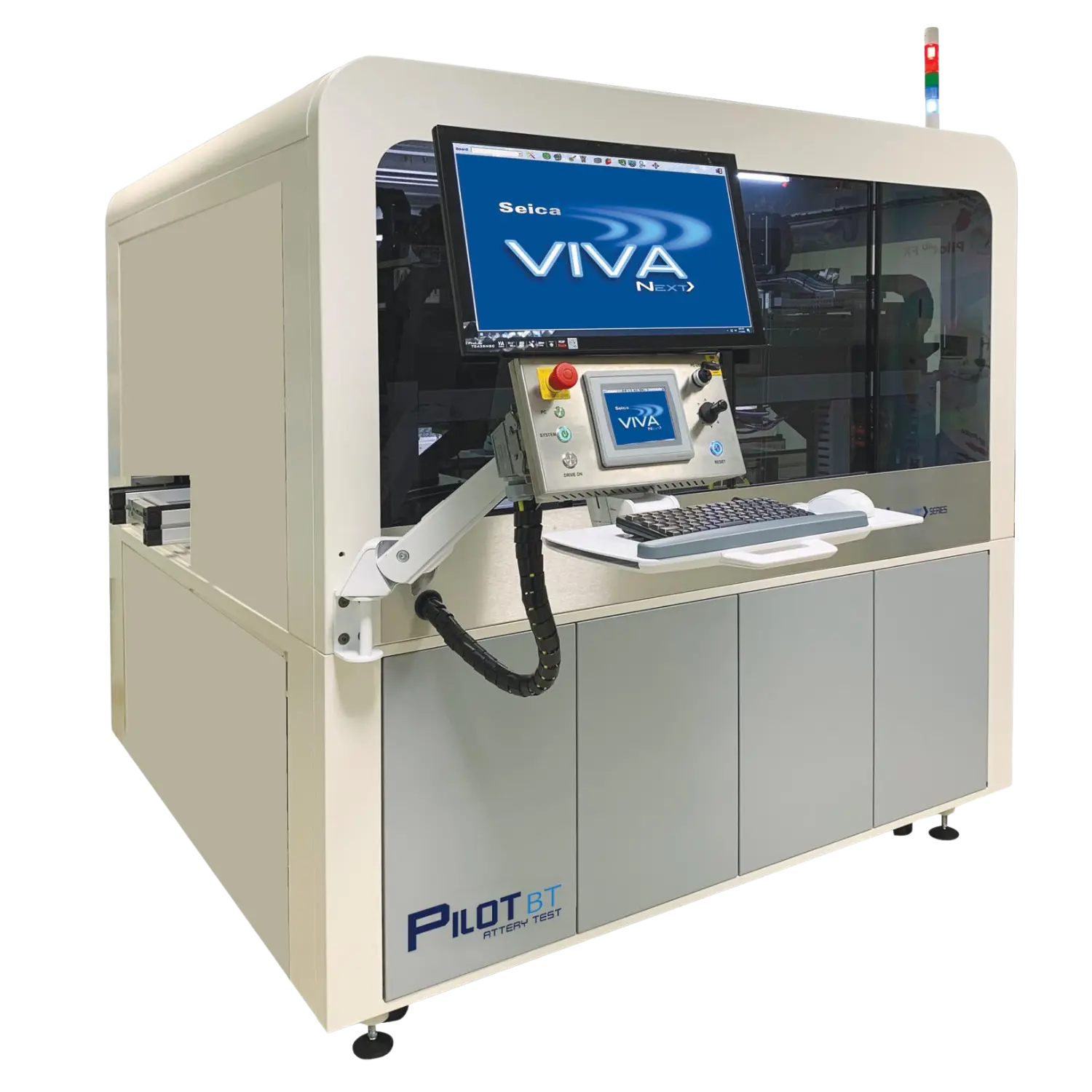
The growing requirements of the electric vehicle market have transformed testing processes for high-volume battery array manufacturing. In order to address these complex technical challenges, the PILOT BT flying prober has been developed as part of the NEXT> Series. This fully automated, verified, and validated system is engineered specifically for testing full-size EV lithium-ion battery packs.
Featuring an expansive testing area of 1050 x 865 mm, the system seamlessly accommodates diverse battery configurations available today while offering the capacity to support future designs. While the standard configuration features a Bosch pass-through conveyance system, alternative customer-specified conveyance solutions can be integrated into fully automated production lines. A reliable, repeatable, and high-production testing solution is available for any battery technology, type, size, or shape.
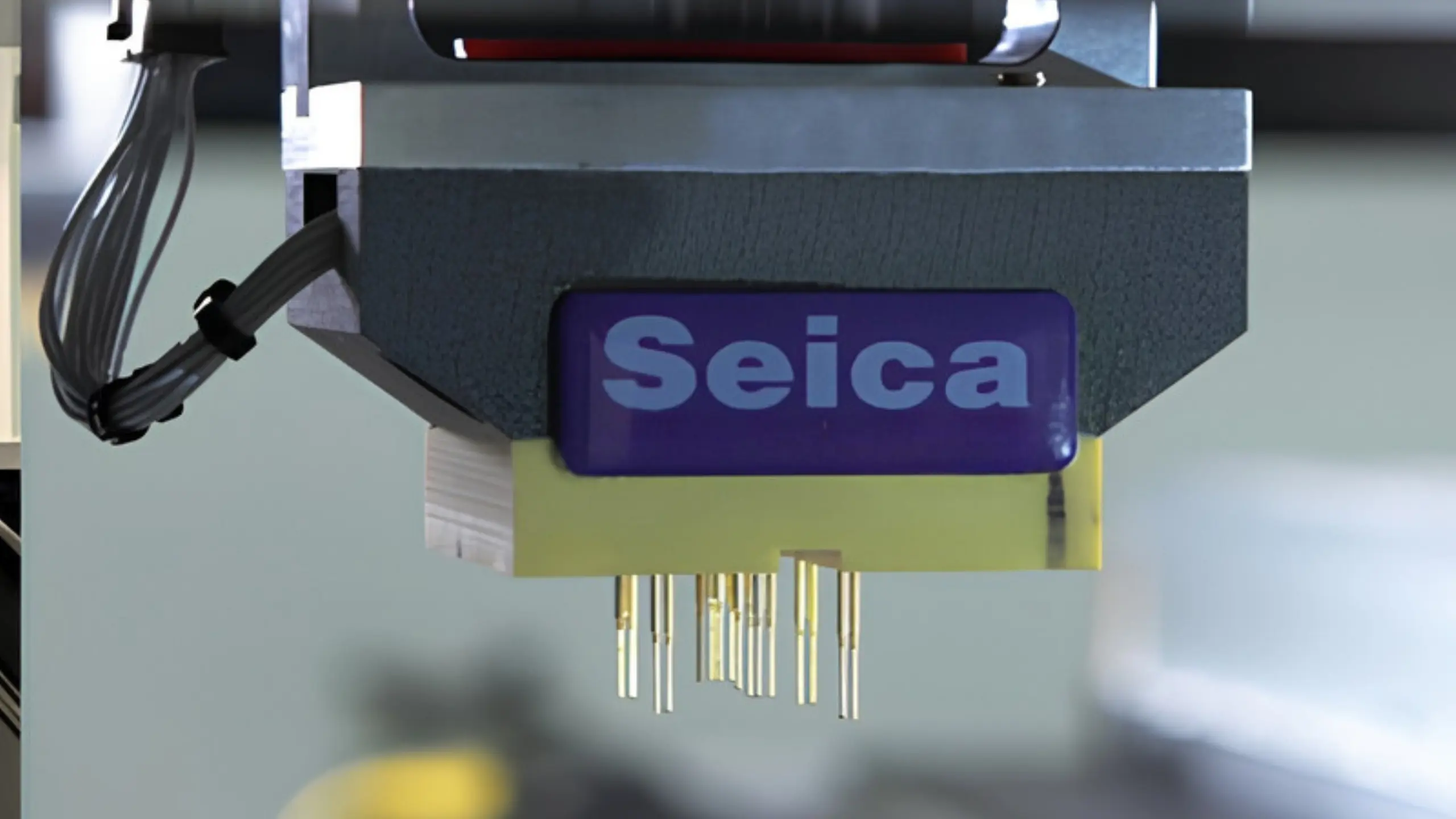
✔ Direct measurements on the four flying heads
The system features up to four independent test heads driven by synchronous brushless motors (XYZ) to provide a high-level dynamic response. Each head includes a mini fixture designed to test up to four individual cells during a single movement in either an X or Y axis orientation
✔ Flying mini-fixture: 4-wire kelvin test
The primary purpose of the tester is to measure the bonding resistance, which is one of the most critical parameters of the battery.
✔ Each of the four mini-fixtures is equipped with:
Four thermally stabilized and insulated resistance meters that enable the measurement of the bonding resistance of a single battery cell to the common plate. The system can discriminate milliohm resistor values with 1 μΩ resolution and high accuracy.
A 200 MHz Digital Signal Processor (DSP) for processing analog measurements to ensure fast and efficient data processing through a 1 Gigabit Ethernet connection with the system PC.
✔ VIVA>NEXT> Software and MES integration Option
Like other Seica solutions, the PILOT BT NEXT> test system utilizes the VIVA>NEXT> platform, providing two authentication methods managed through the proprietary graphic editor MY VIEW:
1. The standard Windows authentication.
2. The VIVA User Authentication, which allows the selection of users with different privileges.
Since production and material flow are managed through MES software, the test system can be connected to the factory MES (Manufacturing Execution System). All customer MES platforms can be integrated through a proprietary adapter.
✔ Battery Testing
One of the main challenges is ensuring the quality and reliability of the electrical connections between battery cells, which are essential for the battery pack’s proper operation.
To meet the growing need for electrical testing of the bonds inside battery packs, a new line of flying probe systems has been introduced: Pilot BT, Pilot BTV, and Pilot BTP.
The Pilot BT system can test the battery pack from the TOP side, performing precise parallel Kelvin tests on more than 32 cells at once, achieving a production rate of almost 4,800 cells per minute in its maximum configuration. It features a large testing area and uses the Bosch handling system to transport batteries.
For more complex battery packs requiring access from multiple sides, the Pilot BTV (Vertical Battery Tester) is available. This flying probe system allows simultaneous and automatic access on three sides. The Pilot BTP is a fully automated, horizontally oriented test system equipped with four flying test heads, enabling full-scale parallel testing and validation of EV battery packs.
The prestigious 2024 Mexico Technology Award in the category of Flying Probe Testing for Electric Vehicles (EV) was awarded to the Pilot BTV system.
✔ ACIR Testing
Another crucial aspect of battery testing is measuring the internal resistance (IR) of the cells. Uneven current distribution can cause dangerous temperature variations within the battery pack. Solutions for both direct current (DCIR) and alternating current (ACIR) resistance measurements are available, with tools like the Mini80 and Mini200, which can be integrated into automated systems or used for manual testing.
✔ Battery Management System (BMS)
The Battery Management System (BMS) is another key component, crucial for the performance, reliability, and lifespan of the battery. To ensure that each BMS meets its specifications, a full functional test is necessary, which involves simulating the real operating conditions the BMS will encounter. The Compact BMS Test System has been developed to carry out comprehensive functional tests, simulating scenarios such as cell balancing and temperature fluctuations, ensuring the system operates correctly under all conditions.
✔ OBC and Inverter
The OnBoard Charger (OBC) module is an essential part of electric vehicles, responsible for recharging the battery pack when the vehicle is stationary. The inverter module serves a similar role, but in reverse, powering the electric motor.
With nearly 40 years of expertise, a trusted partnership is offered for EV manufacturers, delivering innovative and tailored testing solutions to keep pace with the ever-changing market.

 English
  Türkçe